Soundbar vs. Home Theatre System: Which one is right for you?
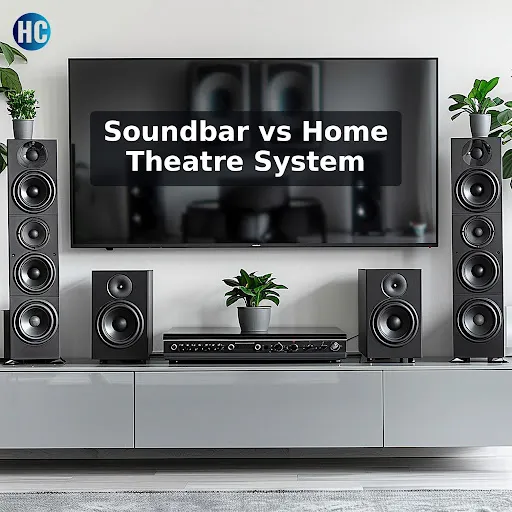
Two popular choices are soundbars and home theatre systems, but they are designed around different priorities. A soundbar combines the main audio channels into a compact unit that can sit below or near the TV, making it a convenient option when space, installation time, or simplicity is important. Depending on the model, a soundbar can also be paired with a wireless subwoofer or rear speakers for a more immersive experience.
There is no single option that works best for everyone. Room size, available space, budget, listening habits, installation requirements, connectivity, and the level of immersion you expect should all be considered before making a decision.
In this guide, we compare soundbars and home theatre systems across these factors to help you understand which setup is better suited to your home.
What’s the Difference between a Soundbar and a Home Theatre System?
The main difference is how each system produces and distributes sound. A soundbar combines multiple speakers and audio processing into a compact unit, usually placed below or near the TV. A home theatre system uses separate speakers positioned around the room, typically with a subwoofer and AV receiver, to create a wider and more immersive sound field.
Before comparing the differences between the two, it is important to first understand what a soundbar and a home theatre system actually are and how each one works for what.
What is a soundbar, and what are its key features?

A soundbar is a long, slim speaker unit designed to improve the audio produced by a TV without requiring a large number of separate components.
It contains multiple speaker drivers, amplifiers, and signal-processing technology within a single enclosure. Some models can also be paired with a separate wireless subwoofer or rear speakers.
Features
- Compact design: Takes up considerably less space than a traditional multi-speaker system.
- Simple installation: Requires minimal wiring and can generally be connected to a TV with a few basic connections.
- Built-in amplification: Integrated amplifiers power the speaker drivers without requiring a separate amplifier in most setups.
- Improved TV audio: Provides clearer dialogue, fuller sound, and better bass.
- Dolby Atmos and DTS:X: Supported on selected models to create a more three-dimensional audio experience.
- Subwoofer support: Many soundbars can be paired with a wireless subwoofer for stronger low-frequency performance.
- Connectivity: Depending on the model, connections can include HDMI ARC/eARC, optical and auxiliary inputs, while Bluetooth and Wi-Fi may be available for wireless streaming.
- Flexible everyday use: Suitable for television, movies, music, gaming, and other entertainment in small to medium-sized rooms.
What is Home Theatre System and its Features?
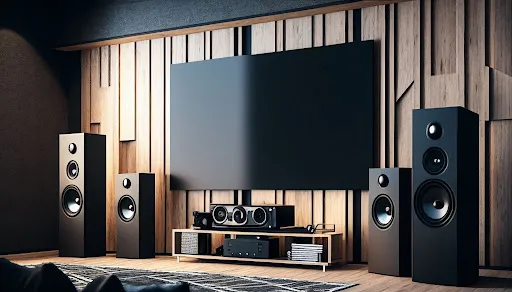
A home theatre system is a multi-component audio setup designed to reproduce a cinema-style sound experience in a home environment.
Unlike a soundbar, it uses separate speakers positioned around the listening area. A typical 5.1 system includes front-left and front-right speakers, a centre speaker, two surround speakers, and a subwoofer. Larger configurations such as 7.1, 5.1.2, and 7.1.4 can add additional surround or height channels for more immersive audio.
Features
- Multiple speakers: Separate front, centre, surround, and height speakers can be positioned around the room according to the selected configuration.
- Dedicated subwoofer: Handles low-frequency effects and adds depth to movie soundtracks, music, and gaming audio.
- True surround sound: Separate speaker positions create directional sound rather than relying primarily on virtual processing.
- AV receiver integration: An AVR can process audio signals, power compatible speakers, manage different channels, and connect multiple entertainment sources.
- Dolby Atmos support: Compatible systems can include dedicated height or ceiling speakers to reproduce overhead sound effects.
- Greater system flexibility: Speakers, subwoofers, AV receivers, and other components can be selected or upgraded according to the room and listening requirements.
- Custom installation: Speaker placement, wiring, acoustic treatment, and calibration can be tailored to the room.
- Suitable for larger spaces: A properly designed multi-speaker system can fill larger living rooms or dedicated cinema rooms more effectively.
Pros and Cons of Soundbars
Pros
1. Space-Saving Design
2. Easy Setup
3. Affordability
4. Aesthetic Appeal
5. Improved Audio Over TV Speakers
Cons
1. Limited Surround Sound
2. Less Customization
3. Bass Limitations
Pros and Cons of Home Theatre System
Pros
1. Immersive Audio
2. Customizable Setup
3. Superior Sound Quality
4. Expandability
Cons
1. Space Requirements
2. Complex Setup
3. Higher Cost
4. Aesthetic Challenges
Soundbar vs. Home Theatre System: Quick Step-by-Step Comparison
| Factor | Soundbar | Home Theatre System |
|---|---|---|
| Sound quality | Clearer dialogue and fuller sound |
|
| Surround sound | Uses speaker arrangement and, on supported models, virtual or Dolby Atmos processing to create a wider sound field | Uses separately positioned speakers to create height channels |
| Bass performance | Depends on the soundbar; models with a separate wireless subwoofer can deliver stronger bass | Dedicated subwoofers generally provide deeper and more powerful low-frequency performance |
| Setup | Suitable for DIY installation | More involved because speakers need to be positioned, connected, and configured |
| Wiring & clutter | Minimal wiring and fewer components | More cables and components, although wireless speakers are available in some systems |
| Space required | Suitable for small to medium-sized rooms | Requires additional space for speakers, subwoofer, AVR, and other components |
| Room size | Suitable for small and medium-sized rooms | Works well in medium to large rooms and dedicated cinema spaces |
| Connectivity | Commonly includes HDMI ARC/eARC and optical; Bluetooth or Wi-Fi may be available depending on the model | Connectivity depends on the AVR and components, with options such as HDMI, optical, network, Bluetooth, and other inputs |
| Upgradability | More limited, although selected soundbars support additional subwoofers or rear speakers | Highly flexible; individual speakers, subwoofers, AV receivers, and other components can be upgraded or expanded |
| Installation | Quick, simple, and usually requires only a few connections | Requires speaker placement, cable management, configuration, and sometimes professional calibration |
| Movies | Improves dialogue, sound effects, and overall TV audio in a compact setup | Creates a more cinematic experience through separate surround speakers and dedicated bass |
| Gaming | Clearer and fuller game audio without requiring multiple speakers | More precise directional sound, helping reproduce effects such as footsteps, vehicles, and movement around the player |
| Music | Convenient for everyday music playback, especially on models with Bluetooth or Wi-Fi | Separate speakers can provide wider sound coverage, greater separation, and more detailed playback |
| Everyday TV viewing | Well suited to regular television, streaming, sports, and casual entertainment | Suited to users who want a dedicated, immersive entertainment setup |
| Cost | Available from budget-friendly to premium price ranges | Usually requires a higher investment, particularly for multi-channel and premium systems |
| Best for | Simplicity, compact spaces, easy installation, and everyday entertainment | Movies and gaming, larger rooms, best for cinema spaces |
Also Read: Denon vs Marantz AV Receivers: Best AV Receiver in 2026
Home Connect Cinemas Recommendation: Which One Should You Choose and What to look for?
A soundbar is a compact and easy-to-install solution for improving TV audio. It takes up little space and is ideal for bedrooms, apartments, or users who prefer a simple setup. Modern models may also support Dolby Atmos and wireless subwoofers.
A home theatre system uses separate speakers, an AV receiver, and usually a subwoofer to deliver a wider, more immersive sound experience.
From our perspective, a properly designed home theatre is the better choice when space and budget allow, while a soundbar is ideal for those who prioritise simplicity and convenience.
In Simple
1. Choose a Soundbar If:
- You want a simple, affordable, and space-saving solution.
- You’re looking for better audio than your TV speakers but don’t need cinematic surround sound.
- You prefer a sleek, modern design.
2. Choose a Home Theatre System If:
- You want the ultimate audio experience with true surround sound.
- You have the space and budget for a more complex setup.
- You’re passionate about movies, music, or gaming and want the best possible sound quality.
Home Connect Cinemas recommends, if space and budget allow, a properly designed home theatre system is the better choice for a cinematic experience; a soundbar is the better option when compactness and convenience are the priority.