10 Best Music Systems That Suits Your Home
Overview
A good home music system should sound clear at the volume you actually listen to, fit your room, and play the music you already use, whether that’s Spotify, a turntable, or the TV. At Home Connect Cinemas, we look at sound quality, features, and value when we help people choose a system, and this list follows the same approach. It covers ten systems, from compact wireless speakers to a full speaker-and-amplifier pair.
Music Systems
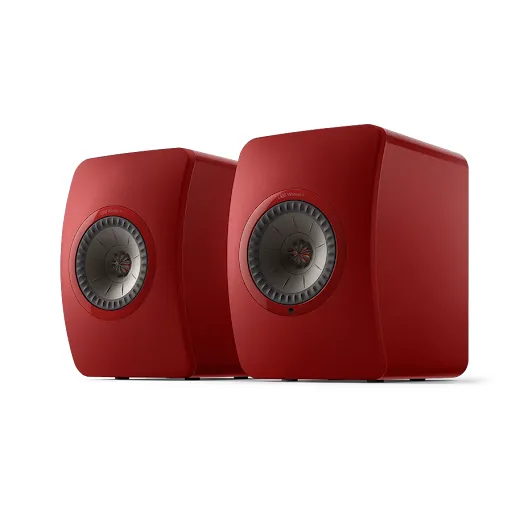
1. KEF LS50 Wireless II
The KEF LS50 Wireless II is a pair of compact active KEF speaker that need no separate amplifier or streamer. It won an award in 2026 and scored 5/5 for sound and features. The reviewer found the treble cleaner, the mids sharper, and the bass tighter than the original LS50 Wireless, with a more open soundstage and better instrument separation.
Key features
- Driver: A 12th-generation Uni-Q driver with a 25 mm vented aluminum tweeter and a 130 mm aluminum mid/bass cone.
- MAT (Metamaterial Absorption Technology): A maze-like structure behind the tweeter that KEF says absorbs about 99% of rear-radiated sound.
- Amplification: 100W Class A/B for the tweeter and 280W Class D for the mid/bass, 380W per speaker in total.
- DSP: KEF’s Music Integrity Engine improves timing, imaging and tightness.
- Streaming: AirPlay 2, Chromecast, UPnP, Roon Ready, Bluetooth, Spotify Connect, Tidal Connect, Amazon Music, Qobuz, Deezer, internet radio and podcasts. It also supports multi-room.
- Hi-res audio: Up to 24-bit/384kHz over the network, with DSD256 and MQA support.
- Inputs and outputs: HDMI eARC, optical, coaxial, 3.5mm aux, Ethernet and subwoofer outputs.
- Speaker link: Wireless at 24-bit/96kHz, or wired by Ethernet at 24-bit/192kHz.
Specs at a glance
- Frequency response: 45 Hz to 28 kHz (±3 dB) and 40 Hz to 47 kHz (−6 dB), depending on EQ settings.
- Max output: 108dB at 1m.
- Size and weight: 305 x 200 x 311 mm per speaker, 20.1 kg for the pair.
- Mounting: Threaded inserts for KEF S2 floor stands, sold separately.
Pros
- A clear step up from the original in performance.
- Clean, punchy sound.
- Comprehensive connectivity, including HDMI eARC for a TV.
Cons
- Best placed on dedicated stands.
- Won’t suit smaller rooms.
- Costs more than most all-in-one systems.
Best for: Buyers who want the best all-in-one sound with streaming and TV connection, in a medium to large room.
2. Arcam SA35
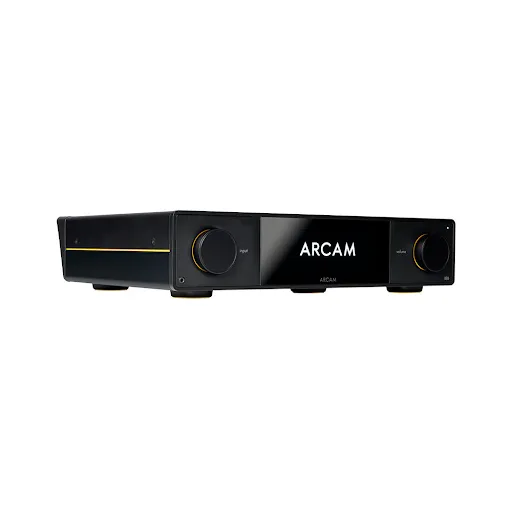
The Arcam SA35 is a streaming integrated amplifier with a built-in DAC, so you only add speakers. It was designed and engineered in Cambridge, UK. The reviewer describes the sound as controlled, precise, and well balanced, with detailed imaging and deep, confident bass.
Key features
- Amplifier: 5th-generation Class G design with 120W per channel into 8 ohms and 200W per channel into 4 ohms.
- DAC: ESS Hyperstream iV in a balanced configuration, with streaming up to 32-bit/384kHz and DSD256.
- Room correction: Dirac Live, with a measurement microphone included.
- Streaming: AirPlay, Google Cast, Spotify Connect, Tidal Connect, Qobuz Connect, Roon, UPnP, internet radio, and podcasts.
- Bluetooth: 5.4, two-way, with LE Audio, Snapdragon Sound, and Auracast.
- Phono: Separate MM and MC inputs for a turntable.
- TV connection: HDMI eARC.
- Inputs: Three RCA pairs, two optical, two coaxial, and a USB-A input.
- Outputs: Dual subwoofer outputs.
- Display: A 6.5-inch bonded display showing album artwork and track details.
- Control: The ARCAM Radia app and a remote.
Specs at a glance
- Distortion: 0.002% THD at 80% power (8 ohms, 1kHz).
- Signal-to-noise: 106 dB analogue and 110 dB digital.
- Size and weight: 432 x 344 x 99 mm and 12 kg.
- Power supply: Linear toroidal transformer, 100–240V, so it suits Indian mains.
- Consumption: 700W maximum and under 0.5W on standby.
Pros
- Balanced, detailed, and tuneful sound.
- Remarkably clean and open delivery.
- A large, bright display.
- A solid build and a very complete feature set.
Cons
- The control app is clunky.
- The remote feels cheap and finicky, and some features need the remote while others need the app.
- Bluetooth is good for general listening but more limited than the other inputs.
- Dirac correction makes the sound more even but may reduce some rhythmic drive.
Best for: Buyers who want one box for streaming, vinyl, TV, and room correction and are happy to choose their own speakers. The Audio T blog describes it as warm and smooth and says its bigger sibling, the SA45, suits larger rooms and louder listening.
3. NAD C 3050 (BluOS)
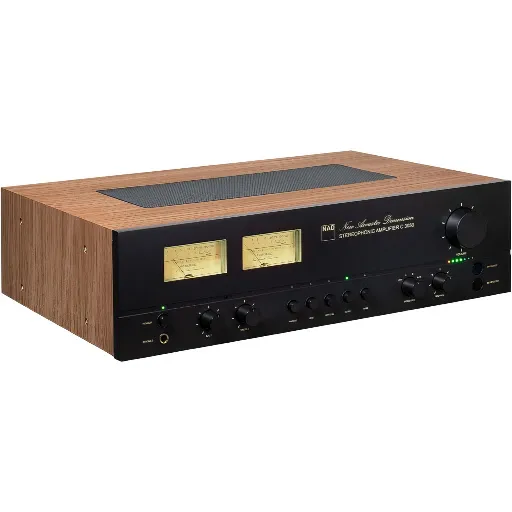
The NAD C 3050 is a retro-styled stereo amplifier with a slot for NAD’s BluOS streaming module. With the module fitted, it becomes a full streaming system, and you only add speakers. NAD describes it as “a throwback to the 70’s, and deliberately so,” while offering modern upgradability. It judged the sound clear, spacious, and expressive, with punchy, controlled bass.
Key features
- Amplifier: NAD’s HybridDigital UcD platform with 100W per channel into 8 or 4 ohms and 135W on short peaks.
- DAC: Texas Instruments PCM5242 differential DAC.
- Streaming (with the MDC2 BluOS-D module): AirPlay 2, Spotify Connect, Tidal Connect, Qobuz Connect, Amazon Music, Deezer, UPnP, internet radio, and Roon. It supports 20+ services and multi-room operation with up to 64 zones.
- Room correction: Dirac Live is included with the module, limited to bass frequencies up to 500Hz. The full-range version is sold separately for about £75 or $99.
- Wireless: Dual-band Wi-Fi, Gigabit Ethernet, and two-way aptX HD Bluetooth.
- TV connection: HDMI eARC.
- Phono: A quiet moving-magnet (MM) stage with infrasonic filtering.
- Other inputs: Optical, coaxial, line-level, and USB-A.
- Outputs: Subwoofers, speaker A/B switching, a dedicated 6.3 mm headphone amplifier and pre-out/main-in jacks for adding a power amp.
- Voice control: Amazon Alexa and Apple Siri through compatible devices.
- Design: A walnut-finished cabinet with a dark grey front, dual VU meters, and push-button source selection.
Specs at a glance
- Distortion: Under 0.03% THD at rated power.
- Size and weight: 450 x 127 x 355 mm and 10 kg.
- Standby: 0.5W in auto standby with network standby off.
Pros
- Clear, spacious, expressive sound.
- Nicely made and finished.
- A good moving-magnet phono stage.
- Retro looks with modern streaming.
Cons
- No DSD support, and PCM is limited to 24-bit/192 kHz.
- No Google Cast.
- The VU meters are small and hard to read from across the room.
- Without the streaming module
- Would struggle against class leaders such as the Arcam A15.
Best for: Buyers who want a stylish amplifier for TV, vinyl, and streaming with the BluOS app and multi-room.
4. Ruark R410
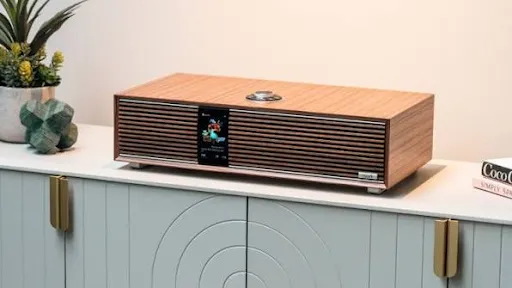
The Ruark R410 is a one-box music system. The amplifier, speakers, streamer, and radio are all built in, so you only add a power cable. Its styling is modern with a retro feel, using a real-wood or lacquered cabinet and a rotary dial. It called the sound “robust and convincing from every source,” with natural tonality and eloquent, direct vocals.
Key features
- Speakers and amplifier: Two 20mm silk dome tweeters and two 100mm NS+ bass-mid drivers in a twin bass-reflex cabinet, driven by a 120W Class D amplifier.
- Streaming: Built-in Spotify Connect, TIDAL Connect and Qobuz Connect, plus Apple AirPlay and Google Cast. Apple Music, Amazon Music, BBC Sounds and Deezer work through casting, and it supports UPnP/DLNA.
- Multi-room: Works with AirPlay and Google Cast speakers, including Ruark’s R610 and R810.
- Radio: Internet radio, DAB/DAB+ and FM with RDS, with a telescopic aerial included.
- Bluetooth 5.1: aptX HD, SBC and AAC. It remembers 8 devices and can send sound to up to 6 pairs of Bluetooth headphones.
- TV connection: HDMI ARC and eARC.
- Other inputs: Stereo RCA line-in, an MM phono stage for a turntable, and optical and USB-C.
- Outputs: A mono RCA subwoofer output.
- CD: Plays CDs through the optional R-CD100 CD player over USB.
- Controls: A RotoDial on the unit, a rechargeable Bluetooth remote, and a 4-inch color display. It has 8 alarms and 20 presets.
- Tone controls: Bass and treble adjustable by ±6 dB, and a switchable Stereo+ mode.
Specs at a glance
- Frequency response: 40 Hz to 22 kHz, typical in-room.
- Hi-res support: FLAC, AIFF, ALAC, and WAV up to 32-bit/192 kHz.
- Size and weight: 132 x 560 x 290 mm (150 x 560 x 325 mm with feet and cables) and 9.5 kg.
- Power: 90–240V, 8W typical, and 2W on standby.
- Finishes: Fused Walnut, Soft Grey Lacquer, and Charcoal Lacquer, all with a Fused Walnut grille.
Pros
- Convincing sound from every source.
- Extensive specification, including HDMI eARC, phono, and radio.
- Stylish modern and retro design.
- Compared with the Naim Mu-so, R410 has more features and a cleaner, more precise sound.
Cons
- It can sound bass-heavy out of the box, though a couple of dB off the bass in the menu evens it out.
- The display is small.
- No control app, which the reviewer called the main drawback.
- An independent DXOMARK test gave it 130 points, ranked 22nd. It found a bright treble, thin mids, AirPlay dropouts, and Bluetooth hum. Its strengths were a wide stereo image and solid low end.
Best for: Buyers who want one stylish box for streaming, radio, vinyl, and TV, with no separate amplifier or speakers to buy.
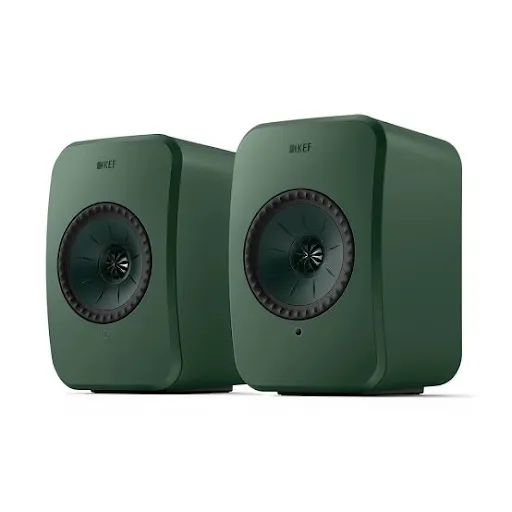
5. KEF LSX II LT
The KEF LSX II LT is a pair of compact active speakers with streaming built in, so you only add a power cable and a source. It is a streamlined, cheaper version of the LSX II, with the same driver, amplification, and sound. T3 also gave it a Platinum Award in 2024. The reviewer described the sound as balanced and controlled, with punchy, well-defined bass and detailed textures.
Key features
- Driver: An 11th-generation Uni-Q array with a 19 mm aluminum dome tweeter and a 115 mm magnesium/aluminum alloy mid/bass cone.
- Amplification: Class D, 100W per speaker (30W for the tweeter and 70W for the mid/bass), 200W for the pair.
- DSP: KEF’s Music Integrity Engine, which improves timing and tonal balance.
- Streaming: AirPlay 2, Chromecast, UPnP, Spotify Connect, Tidal Connect, Amazon Music, Qobuz, Deezer, internet radio, and podcasts.
- Wireless: Dual-band Wi-Fi and Bluetooth 5.0.
- Resolution: Up to 24-bit/384kHz over the network, with DSD support.
- Inputs: HDMI ARC for a TV, optical, USB-C, and Ethernet.
- Output: An RCA subwoofer output with an adjustable crossover.
- Multi-room: Works with other KEF LS Wireless speakers.
- Design: By Michael Young, in satin matte Sage Green, Graphite Grey or Stone White. A remote is included, and there are no buttons on the speakers.
- Mounting: Inserts for KEF’s P1 desk pad and S1 floor stand, sold separately.
Specs at a glance
- Frequency response: 54Hz to 28kHz (±3dB) and 49Hz to 47kHz (−6dB), depending on EQ.
- Max output: 102dB at 1m.
- Size and weight: 240 x 155 x 180 mm per speaker, 6.8 kg for the set.
- Room size: KEF suggests 5 to 40 m².
- Power: One power cable, 100–240V, under 2W on standby. The second speaker is powered through the link cable.
What it leaves out compared with the LSX II
- No 3.5 mm analogue input.
- No Roon Ready, no MQA.
- No wireless link between the speakers. A wired USB-C cable joins them.
Pros
- A cohesive, balanced sound with full, well-formed bass for its size.
- Excellent detail, soundstaging, and imaging.
- Natural dialogue and well-defined effects with TV.
- Easy setup, a useful EQ, and a compact, desk-friendly size.
Cons
- Bass depth is limited compared with larger systems.
- No analogue input and no wireless speaker link.
- Occasional hardness on loud, demanding passages, and Chromecast tracks can take 5 to 6 seconds to load.
- The finish is plastic and less luxurious than the LSX II’s fabric and lacquer.
Best for: Small to medium rooms, desks, and TV setups where you want compact, precise sound with streaming and no extra boxes. The SoundStage Simplifi reviewer said it “belongs on your shortlist, at or near the top.”
6. Triangle AIO Twin
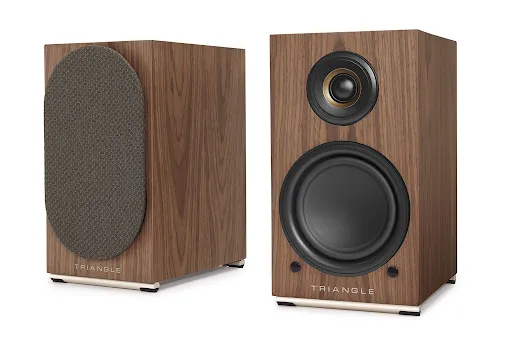
The Triangle AIO Twin is a stereo pair of active speakers with streaming built in. One “master” speaker holds the amplifier and connects to the second with a 3m cable. The reviewer found it fun, agile, and composed across genres, with taut bass, clear vocals in a spacious soundfield, and clean treble.
Key features
- Drivers: A 25 mm silk dome tweeter and a 13 cm mid/bass driver per speaker, in a two-way bass-reflex cabinet.
- Amplifier: Class D, 2 x 50W RMS, with a frequency response of 56Hz to 22kHz (±3dB).
- Streaming: Wi-Fi, AirPlay, Spotify Connect, UPnP/DLNA, Spotify, Tidal, Qobuz, Deezer, Amazon Music, Napster, and TuneIn internet radio, with resolution up to 24-bit/192 kHz.
- Bluetooth 5.0: aptX, aptX HD, aptX LL, SBC, and AAC.
- Phono: A built-in moving-magnet (MM) stage, switchable to line level for a CD player or tuner.
- TV and other inputs: Optical, 3.5 mm, USB-A (also charges devices), RJ45 Ethernet and an RCA subwoofer output.
- Multi-room: Linkplay-based, working with other Triangle AIO products such as the AIO 3 and AIO Pro A50.
- App and remote: The free Triangle AIO app for iOS and Android, plus an IR remote, a volume knob on the master speaker, an alarm clock, and auto-standby.
- Design: Seven finishes, including real wood Macassar veneer, with a fabric front panel and magnetic grilles.
- Room size: Triangle recommends rooms up to 25 m², with a subwoofer for larger ones.
Specs at a glance
- Size and weight: 165 x 304 x 235 mm and 5 kg per speaker.
- Included: A 3 m speaker cable, remote, and grilles.
Pros
- Enthusiastic, capable sound for the price.
- An elegant, classy design.
- Versatile features and connectivity, including phono and optical.
- A good app.
- A rare mix of vinyl and network streaming in one stereo pair.
Cons
- The phono stage is less clear and expressive than the other inputs, so serious vinyl listeners should add a separate phono stage.
- Bass is punchy but not deep, and one measurement shows a roll-off below 90Hz.
- The rear-firing ports need space from walls.
- A cable is needed between the speakers.
Best for: Buyers who want wireless streaming, Bluetooth, vinyl, and TV connections from one compact stereo pair at a moderate price. KEF LSX II, which costs about twice as much, as a step up.
7. Denon D-M41DAB
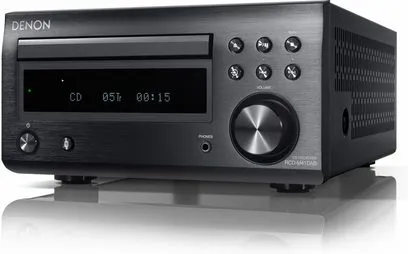
The Denon D-M41DAB is a compact CD, radio, and Bluetooth system. It comes as a CD receiver with Denon’s matching SC-M41 speakers. It named it a 2026 Awards winner and called its performance “remarkably human” for the price. Compared with the older D-M40DAB, it found a more spacious soundstage, more detail, and more expressive dynamics, with an even balance that is more forward and lively.
Key features
- Amplifier: A stereo amplifier with 2 x 30W (8 ohms) and a redesigned analog circuit with shorter signal paths.
- Triple Noise Reduction Design: Separate analog and digital circuits, plus improved grounding.
- CD player: Plays music CDs and CD-R/CD-RW discs with MP3 files and WMA.
- Radio: DAB, DAB+, and FM with RDS.
- Bluetooth: New to this range, and it can be switched off.
- Inputs: One analog input and two optical inputs, so a TV, games console, or media player connects easily.
- Outputs: A subwoofer pre-out and a headphone output.
- Controls: Bass, treble, and balance, plus a clock, sleep timer, programmable timer, and a remote.
- SC-M41 speakers: Each has a 12 cm mid/bass driver and a 25 mm soft-dome tweeter, returned for this model, with a heavier speaker cable.
- Display: Flatter, to reduce reflections.
- Finishes: Black/Black, Silver/Black, and Silver/Cherry Wood.
Specs at a glance
- Size and weight: 210 x 308 x 115 mm and 4.2 kg for the receiver.
- Power: 70W consumption and 0.3W on standby.
Pros
- A clear, across-the-board sound improvement over the previous model.
- Bluetooth is well integrated.
- Stable, solid sound, even with the speakers away from a rear wall.
- Works well with the matching SC-M41 speakers.
- Reviewers say it competes with separate components that cost more.
Cons
- No network streaming, as it has no Wi-Fi or Ethernet.
- The USB input was removed, so USB drives can’t be played.
- The reviews list no other cons, only “nothing at this price.”
Best for: Budget buyers who like CDs, FM radio, and Bluetooth in a small room or on a desk, with a TV connection through optical.
8. WiiM Amp Pro
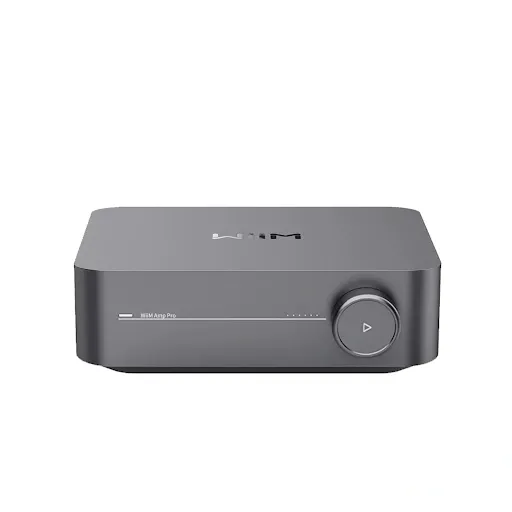
The WiiM Amp Pro is a compact streaming amplifier in an aluminum case. It is a “just add speakers” box that streams over Wi-Fi and connects to your TV. It describes the sound as clean, open, and smooth, with clearly projected voices and a clear step up from the original WiiM Amp.
Key features
- Amplifier: TI TPA3255 Class D with 60W per channel into 8 ohms and 120W per channel into 4 ohms.
- DAC: ESS ES9038 Q2M, supporting up to 24-bit/192kHz.
- Streaming: Spotify Connect, Tidal Connect, Qobuz Connect, Google Cast, DLNA and Roon Ready. Amazon Music works through Alexa Cast, and the app also covers Deezer and TuneIn.
- Wireless: Wi-Fi 6, Ethernet and Bluetooth 5.3, which works in both directions.
- TV connection: HDMI ARC, for stereo PCM and Dolby Digital. DTS isn’t supported.
- Other inputs: Optical, RCA line-in and USB-A for storage.
- Outputs: Speaker terminals, a subwoofer output with an adjustable crossover, and a USB audio output for an external DAC.
- Room correction and EQ: RoomFit room correction in the app, with 10-band graphic and parametric EQ and per-input settings.
- App: The WiiM Home app handles multi-room grouping, stereo pairing, alarms and sleep timers.
- Controls: A volume dial and LEDs, and no display.
- In the box: HDMI, optical, and RCA cables.
Specs at a glance
- Distortion: 0.0005% THD+N at 5W, a figure Audacity Australia credits to Audio Science Review.
- Size and weight: 190 x 190 x 63 mm and 1.84 kg, in silver or space grey.
- Power: 100–240V.
Pros
- Clear, detailed, punchy sound for the price.
- Compact, well-made and easy to set up.
- Wide connectivity, including HDMI ARC and many streaming platforms.
- Flexible EQ and room correction at a budget price.
- Audacity Australia scored it 92/100, with a 10/10 for value.
Cons
- No AirPlay, so Apple devices need another route.
- No headphone output and only one line-in.
- No display.
- A little restrained in rhythmic timing and textural depth, and less micro-detail than pricier amps such as the Yamaha WXA-50.
- It can clip slightly at high volume with demanding speakers, so efficient speakers suit it best.
Best for: Buyers on a budget or short of space, such as people upgrading from a soundbar or an entry-level setup, who want to bring their own speakers and don’t need AirPlay.
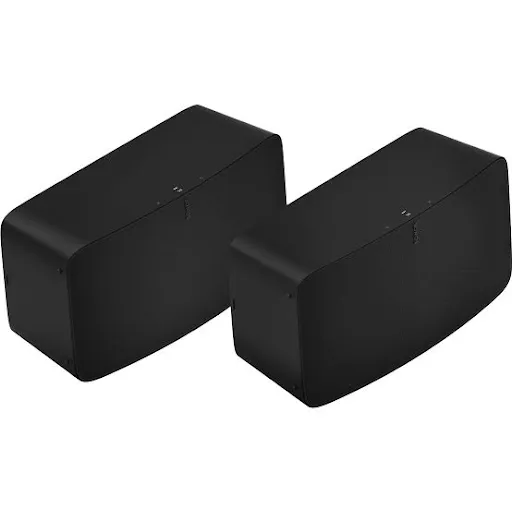
9. Sonos HiFi Set (2 x Five)
The Sonos HiFi Set is a bundle of two Sonos Five wireless speakers, set up as a left and right stereo pair. Best Buy sells it as a “Sonos Five High-Fidelity Wireless Speaker, Black (2 pack).” Each Five is a large Wi-Fi speaker that you control from the Sonos app. There is no separate amplifier or receiver. Pair two in the app and you get a full stereo system. What Hi-Fi? scored the Five 4 for sound, 4 for features, and 5 for build, and called it “bold, expansive sound and great multi-room potential.”
Key features (per speaker)
- Drivers and amps: Three tweeters, three mid-woofers, and six Class D amplifiers, one for each driver. The two outer tweeters angle outward to widen the stereo image, and the center tweeter handles vocals.
- Connections: Wi-Fi, Ethernet, and a 3.5 mm analog line-in. Apple AirPlay 2 works for iPhones.
- Line-in: Connect a turntable with a built-in phono preamp, a CD player, or another source, and the Five streams it to the other Sonos speakers. A turntable without a preamp needs an inline phono preamp.
- Room tuning: Trueplay measures the room and adjusts the sound. It uses the microphone on an iPhone or iPad, so Android gets only a simpler version.
- Orientation: Lying flat, a single Five plays stereo. Stood upright, it plays mono, which is how Sonos intends a pair to be used. Smart Home Assistant and World Wide Stereo say a pair gives the best stereo imaging this way.
- Control: The Sonos app, with EQ and balance settings, plus top-panel buttons for play, pause, volume, and skip.
- Multi-room: Any Five can join a group with other Sonos speakers. It can also act as a rear speaker for a Sonos Beam or Arc.
- Extras: Humidity resistance, according to World Wide Stereo.
- Size and weight: 364 x 203 x 154mm (W x H x D) and 6.4 kg each (World Wide Stereo gives 14 lbs).
- Colors: Black or white.
What does it sound like
It found the sound big and room-filling, with a spacious, coherent soundstage and strong midrange. Treble was slightly rounded off. Before Trueplay, the bass dominated and lacked definition. After Trueplay, it improved but stayed a little overconfident. The Five can play loud without changing character. World Wide Stereo’s reviewer said the bass “almost sounds like it has a subwoofer attached to it.”
Pros
- Big, room-filling sound with strong bass.
- A single box per side, so the system looks tidy.
- Line-in for a turntable or other analog source.
- Ethernet for a steadier connection.
- TruePlay, AirPlay 2, and multi-room.
- Solid build quality.
Cons
- Bass can be heavy, even after Trueplay.
- Slightly rounded treble.
- No Bluetooth.
- No built-in microphone, so no voice assistant.
- Trueplay’s full tuning is iOS only.
- It uses the Sonos app, and one commenter on World Wide Stereo’s page said they found it weak.
- Suggests shoppers look at other products, especially for stereo listening.
10. Paradigm Founder 80F with Anthem STR
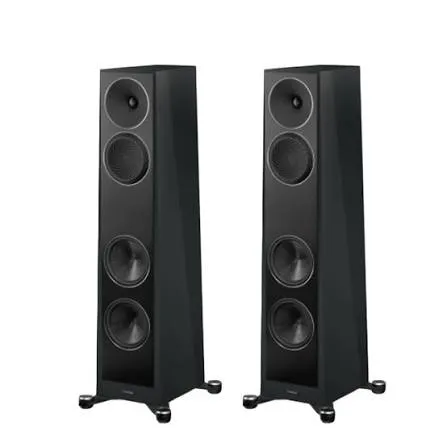
The Paradigm Founder 80F is a 2.5-way floorstanding speaker with a ported cabinet. Paradigm Speakers makes it in Canada, and it is the step-up model in the Founder range, above the 40B bookshelf. The Anthem STR is a high-power stereo integrated amplifier from the same company. The pair gives you a two-channel system built to fill a living room with clear, loud, and controlled sound. Neither product is a home theater receiver.
Key features: Paradigm Founder 80F
- Drivers: One 1-inch AL-MAC ceramic dome tweeter, one 6-inch AL-MAG mid/bass cone, and two 6-inch CARBON-X bass cones.
- Waveguide and lens: The tweeter and mid/bass driver use an Oblate Spheroid Waveguide (OSW) and a Perforated Phase-Aligning (PPA) lens for even, wide dispersion.
- Cabinet: Faceted, ¾-inch MDF with Cascade-Fusion bracing. Shock-mount isolation on the drivers and shock-mount feet. The feet adjust from above, and the box includes hardware for carpet and hard floors.
- Frequency response: ±2 dB from 50 Hz to 23 kHz on-axis, down to 28Hz (DIN).
- Sensitivity: 93dB in-room and 90dB anechoic.
- Impedance: 8 ohms compatible.
- Amplifier power: 15 to 220W suitable, 180W maximum input.
- Crossover: Second-order, at 500 Hz and 1.8 kHz.
- Size and weight: 97.1 x 29.8 x 35.6 cm and 23.6 kg each.
- Finishes: Piano Black, Black Walnut, Midnight Cherry, and Walnut.
Key features: Anthem STR integrated amplifier
- Power: 200W per channel into 8 ohms, 400W into 4 ohms, and 550W into 2 ohms.
- Digital inputs: Coaxial (2), optical (2), AES/EBU, and asynchronous USB. USB handles up to 32-bit/384kHz PCM and native DSD up to 5.6MHz.
- Analog inputs: Four line-level stereo inputs, one balanced XLR, and moving-magnet and moving-coil phono.
- Outputs: Stereo pre-out (fixed and variable) and two subwoofer outputs, with bass management.
- Room correction: Anthem Room Correction (ARC).
- Control: Ethernet, RS-232, 12V trigger, and IR remote.
- Size and weight: 17 x 6.75 x 17.5 inches (about 43 x 17 x 44 cm) and 40 lbs (about 18 kg).
Why they work together
The Founder 80F is easy to drive at 93 dB in-room sensitivity and 8 ohms. It can also take far more power than a small amplifier gives. The STR delivers 200W into 8 ohms, which sits at the top of the speaker’s 15 to 220W range, so it has plenty of headroom for loud, clean peaks. ARC adds room correction to the setup, and the STR’s two sub outputs let you add a subwoofer later. Paradigm says the 80F isn’t meant to replace a subwoofer. The pairing makes sense on paper. None of the six pages tested the two together, so I can’t vouch for how it sounds as a system.
What it sounds like
StereoNET scored the 80F 8/10 and gave it an Applause Award. The reviewer called the sound clean, detailed, balanced, and musical, with tight, punchy bass and a smooth treble that never turned harsh. Imaging was large and spacious, off-axis listening held up well, and the speaker wasn’t fussy about placement. Audio Advice describes it as lively and open, with big dynamics and a large soundstage for its size.
Pros
- Clean, balanced sound with strong dynamics at high volume.
- Large soundstage and good off-axis performance.
- Easy to place and easy to drive.
- Tight bass for a cabinet this size.
- Well-finished, with a magnetic grille and adjustable feet.
- The STR gives phono, XLR, a DAC, and room correction in one box.
Cons
- Less bass weight than bigger speakers. StereoNET found it lighter than the JBL HDI-3800 in bass and dynamic range and suggests the Founder 100F for larger rooms.
- StereoNET found that the magnetic grille slightly changed the sound and listened without it.
- The STR has no HDMI and no built-in streaming, so a TV or a network player needs another route.
- The STR costs far more than most amplifiers that suit the 80F.
Best for: Music-first listeners who want a serious two-channel system with real power in reserve and who are happy to add a subwoofer or streamer later.
Also Read this: Top 10 Premium Home Theater Brands (2026)
How to Choose a Music System That Suits Your Home?
The right music system depends on your room, how you listen, and what you already own. Work through these steps in order, and the shortlist usually shrinks fast. At Home Connect Cinemas, we use the same steps when we help buyers choose.
1. Decide what you’ll mainly use it for.
Music alone suits a two-channel stereo system: a pair of speakers, an amplifier, and a source. Movies and gaming suit a multichannel home theatre system, which adds a center speaker, surround speakers, and a subwoofer. A stereo system can play dialogue-heavy TV well, but it won’t give surround effects. Gamers should also look for low-latency connections.
2. Match the system to your room
Bajaj Finserv’s guide gives rough room sizes. Up to about 150 sq. ft. suits a soundbar or a 2.1 system, and 150 to 250 sq. ft. suits a 3.1 or 5.1 system. Above 250 sq. ft. suits 5.1, 7.1, or Dolby Atmos. Those figures come from one retailer guide, so treat them as a starting point. The other guides agree on the principle without giving numbers: bigger isn’t better, and the system should fit the room and your listening distance.
3. Pick the right speaker type
- Bookshelf speakers: For small rooms, bedrooms, and desks. They give clear stereo imaging and often need stands.
- Floorstanding speakers: For medium and large rooms. They give more bass and scale but can overpower a small room.
- In-wall and in-ceiling speakers: For a clean look and multi-room audio. Plan these before renovation.
- Wireless or all-in-one systems: For small rooms and already-finished homes. They need no separate amplifier.
4. Check the connections.
Look for HDMI ARC or eARC if the system will connect to a TV, and Bluetooth, Wi-Fi, or AirPlay if you stream from a phone. Check for a phono input if you play vinyl. Wired connections are steadier, while wireless is easier to place but can be affected by interference or a crowded network. For a whole-house system, Elite Smart Home advises hardwired connections and running cable during a remodel.
5. Think about the room itself
Room size, hard surfaces, and windows all change the sound. Rugs, curtains and soft furnishings absorb harsh reflections. Elite Smart Home suggests placing a subwoofer mid-wall, not in a corner, for smoother bass. Digital room calibration, such as Trueplay on Sonos or ARC on Anthem, can correct bass buildup.
6. Don’t ignore your source
SG Live Acoustics points out that a low-quality source limits any system. Use high-quality streaming or well-mastered files, and for vinyl, remember that the turntable, cartridge, and phono stage all matter.
7. Set a budget, including extras
Set the budget first, since it narrows the choice quickly. Leave room for installation, cables, and stands. Watt Hi-Fi adds a useful rule: pay only for the features you’ll actually use, and consider a system you can expand later.
8. Listen before you buy
Test with music you know well. Listen for clear vocals, bass that is deep but controlled, and no distortion at higher volume. SG Live Acoustics adds that some people prefer a warm, relaxed sound and others a fast, precise one, so your own taste matters.
Home Connect Cinemas welcomes you to visit and hear systems in person in Angamaly before you decide.